Author: sahaymaniceet

  • 10 Decision Tree Questions Every Data Scientist Needs to Know

    You may or may not be asked such questions in an interview, but often these kind of questions come up in screening tests which have MCQs.

  • Correlation between numerical and categorical variable – Point Biserial Correlation

    We all know about Pearson correlation among numerical variables. But what if your target is binary and you want to calculate the correlation between numerical features and binary target. Well, you can do so using point-biserial correlation.

    The point-biserial correlation coefficient is a statistical measure that quantifies the relationship between a continuous variable and a dichotomous (binary) variable. It is an extension of the Pearson correlation coefficient, which measures the linear relationship between two continuous variables.

    The point-biserial correlation coefficient is specifically designed to assess the relationship between a continuous variable and a binary variable that represents two categories or states. It is often used when one variable is naturally dichotomous (e.g., pass/fail, yes/no) and the other variable is continuous (e.g., test scores, age).

    The coefficient ranges between -1 and +1, similar to the Pearson correlation coefficient. A value of +1 indicates a perfect positive relationship, -1 indicates a perfect negative relationship, and 0 indicates no relationship.

    The calculation of the point-biserial correlation coefficient involves comparing the means of the continuous variable for each category of the binary variable and considering the variability within each category. The formula for calculating the point-biserial correlation coefficient is:

    r_{pb} = \frac{M_{1} - M_{0}}{s_{n}}\sqrt{pq}

    Here

    • M1 is the mean of the continuous variable for category 1 of the binary variable.
    • M0 is the mean of the continuous variable for category 0 of the binary variable.
    • s_{n} is the standard deviation of the entire population if available.
    • p = Proportion of cases in the “0” group.
    • q = Proportion of cases in the “1” group.

    You can also easily calculate this in Python using the scipy library.

    import scipy.stats as stats
    
    # Calculate the point-biserial correlation coefficient
    r_pb, p_value = stats.pointbiserialr(continuous_variable, binary_variable)
    

    Let me know in the comments in case you’ve any questions regarding the point-biserial correlation.

  • Using Custom Eval Metric with Catboost

    Catboost offers a multitude of evaluation metrics. You can read all about them here, but often you want to use a custom evaluation metric.

    For example in this ongoing Kaggle competition, the evaluation metric is Balanced Log Loss. Such a metric is not supported by catboost. By this I mean that you can’t simply write this and expect it to work.

    from catboost import CatBoostClassifier
    model = CatBoostClassifier(eval_metric="BalancedLogLoss")
    model.fit(X,y)

    This will give you an error. What you need to define is a custom eval metric class. The template for which is pretty simple.

    class UserDefinedMetric(object):
        def is_max_optimal(self):
            # Returns whether great values of metric are better
            pass
    
        def evaluate(self, approxes, target, weight):
            # approxes is a list of indexed containers
            # (containers with only __len__ and __getitem__ defined),
            # one container per approx dimension.
            # Each container contains floats.
            # weight is a one dimensional indexed container.
            # target is a one dimensional indexed container.
    
            # weight parameter can be None.
            # Returns pair (error, weights sum)
            pass
    
        def get_final_error(self, error, weight):
            # Returns final value of metric based on error and weight
            pass


    Here there are three parts to the class.

    1. get_final_error – Here you can just return the error, or if you want to modify the error like take the log or square root, you can do so.
    2. is_max_optimal – Here you return True if greater is better like accuracy etc, otherwise return False.
    3. evaluate – Here lies the meat of your code where you’ll actually write what metric you want. Remember that the approxes are the predictions and you need to take approxes[0] as the output.

    Below you will find the code for Balanced Log Loss as an eval metric.

    
    class BalancedLogLoss:
        def get_final_error(self, error, weight):
            return error
    
        def is_max_optimal(self):
            return False
    
        def evaluate(self, approxes, target, weight):
            y_true = target.astype(int)
            y_pred = approxes[0].astype(float)
            
            y_pred = np.clip(y_pred, 1e-15, 1 - 1e-15)
            individual_loss = -(y_true * np.log(y_pred) + (1 - y_true) * np.log(1 - y_pred))
            
            class_weights = np.where(y_true == 1, np.sum(y_true == 0) / np.sum(y_true == 1), np.sum(y_true == 1) / np.sum(y_true == 0))
            weighted_loss = individual_loss * class_weights
            
            balanced_logloss = np.mean(weighted_loss)
            
            return balanced_logloss, 0.0

    Then you can simply call this in your grid search or randomised search like this –model = CatBoostClassifier(verbose = False,eval_metric=BalancedLogLoss())

    Write in the comments below if you’ve any questions related to custom eval metrics in Catboost or any ML framework.

  • Balanced Log Loss, Metric for imbalanced classification problems

    We all know about LogLoss which is the main loss function when it comes to binary classification problems. The formula is given below –


    LogLoss = -\frac{1}{N} \sum_{i=1}^{N} \left( y_i \log(p_i) + (1 - y_i) \log(1 - p_i) \right)

    • (N) is the total number of samples.
    • (y_i) is the true label of sample (i) (0 or 1).
    • (p_i) is the predicted probability of sample (i) belonging to class 1.

    Imbalanced Log Loss:
    The imbalanced log loss accounts for class imbalance by introducing class weights. It can be defined as:


    ImbalancedLogLoss = -\frac{1}{N} \sum_{i=1}^{N} w_i \left( y_i \log(p_i) + (1 - y_i) \log(1 - p_i) \right)

    • (N) is the total number of samples.
    • (y_i) is the true label of sample (i) (0 or 1).
    • (p_i) is the predicted probability of sample (i) belonging to class 1.
    • (w_i) is the weight assigned to sample (i) based on its class label. For example, if class 0 has fewer samples than class 1, (w_i) can be set to the ratio of class 1 samples to class 0 samples.

    Here is the python code that you can call to evaluate in Catboost –

    class BalancedLogLoss:
        def get_final_error(self, error, weight):
            return error
    
        def is_max_optimal(self):
            return False
    
        def evaluate(self, approxes, target, weight):
            y_true = target.astype(int)
            y_pred = approxes[0].astype(float)
            
            y_pred = np.clip(y_pred, 1e-15, 1 - 1e-15)
            individual_loss = -(y_true * np.log(y_pred) + (1 - y_true) * np.log(1 - y_pred))
            
            class_weights = np.where(y_true == 1, np.sum(y_true == 0) / np.sum(y_true == 1), np.sum(y_true == 1) / np.sum(y_true == 0))
            weighted_loss = individual_loss * class_weights
            
            balanced_logloss = np.mean(weighted_loss)
            
            return balanced_logloss, 0.0

    Advantages of Imbalanced LogLoss –

    1. Handles Class Imbalance: The imbalanced log loss takes into account the class distribution and assigns appropriate weights to each class. This allows the model to effectively handle imbalanced datasets, where one class may have significantly fewer samples than the other. By assigning higher weights to the minority class, the model focuses more on correctly classifying the minority class, reducing the impact of class imbalance.
    2. Improves Model Performance: By incorporating class weights in the loss function, the imbalanced log loss guides the model to optimize its predictions specifically for imbalanced datasets. This can lead to improved model performance, as the model becomes more sensitive to the minority class and learns to make better predictions for both classes.
    3. Flexible Weighting Strategies: The imbalanced log loss allows flexibility in assigning weights to different classes. Various weighting strategies can be used based on the characteristics of the dataset and the specific problem at hand. For example, weights can be inversely proportional to class frequencies or can be set manually based on domain knowledge. This flexibility enables the model to adapt to different levels of class imbalance and prioritize the correct classification of the minority class accordingly.
    4. Evaluation Metric Consistency: When using the imbalanced log loss as both the training loss and evaluation metric, it ensures consistency in model optimization and evaluation. By optimizing the model to minimize the imbalanced log loss during training, the model’s performance is directly aligned with the evaluation metric, providing a fair assessment of the model’s effectiveness in handling class imbalance.

    In conclusion, if you have an imbalanced class problem, you can try this eval metric in your models as well.

    .

  • Cohen’s D – How to measure the difference in distributions

    While the t-test or Mann-Whitney U test can tell you whether two distributions are different from each other, it doesn’t tell you the degree to which they are different.

    For this purpose, you can calculate Cohen’s D.

    Cohens'D = \frac{(M1-M2)}{S_{pooled}}

    Where the pooled standard deviation can be defined as

    S_{pooled} = \sqrt{\frac{s_{1}^{2} + s_{1}^{2}}{2}}

    After calculating Cohen’s D you can gauge the difference via this thumb rule –

    • Small effect = 0.2
    • Medium Effect = 0.5
    • Large Effect = 0.8

    Below you can find the code to calculate Cohen’s D in python

    import numpy as np
    
    def cohens_d(x,y):
        var_x = np.var(x)
        var_y = np.var(y)
        mean_x = np.mean(x)
        mean_y = np.mean(y)
        pool_variance = np.sqrt((var_x**2 + var_y**2)/2)
        return (mean_x - mean_y)/pool_variance

    Write in the comments in case you’ve any questions regarding cohen’s D.

  • MSE vs MSLE, When to use what metric?

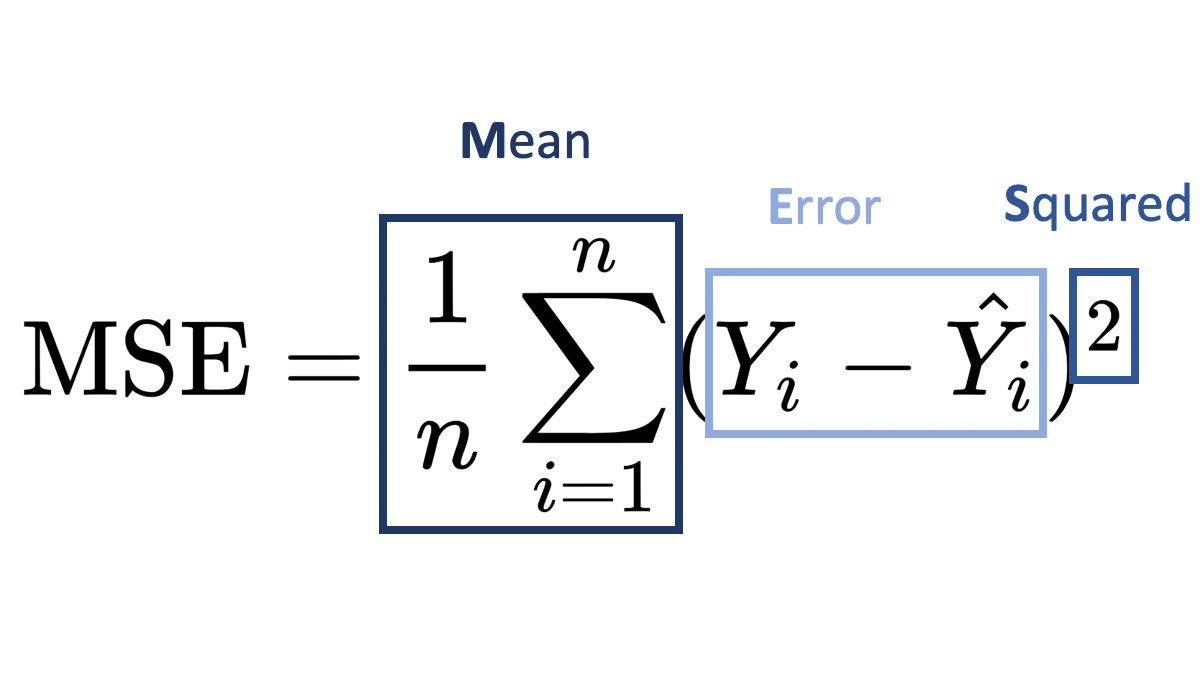
    MSLE (Mean Squared Logarithmic Error) and MSE (Mean Squared Error) are both loss functions that you can use in regression problems. But when should you use what metric?

    Mean Squared Error (MSE):

    It is useful when your target has a normal or normal-like distribution, as it is sensitive to outliers.

    An example is below –

    In this case using MSE as your loss function makes much more sense than MSLE.

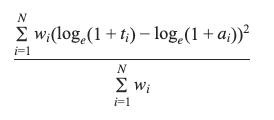
    Mean Squared Logarithmic Error (MSLE):

    • MSLE measures the average squared logarithmic difference between the predicted and actual values.
    • MSLE treats smaller errors as less significant than larger ones due to the logarithmic transformation.
    • It is less sensitive to outliers than MSE since the logarithmic transformation compresses the error values.

    An example where you can use MSLE –

    Here if you use MSE then due to the exponential nature of the target, it will be sensitive to outliers and MSLE is a better metric, remember that MSLE cannot be used for optimisation, it is only an evaluation metric.

    In general, the choice between MSLE and MSE depends on the nature of the problem, the distribution of errors, and the desired behavior of the model. It’s often a good idea to experiment with both and evaluate their performance using appropriate evaluation metrics before finalizing the choice.

  • Numpy Argpartition – How it works?

    We all know that to find the maximum value index we can use argmax, but what if you want to find the top 3 or top 5 values. Then you can use argpartition.

    Let’s take an example array.

    x = [10,1,6,8,2,12,20,15,56,23]

    In this array, it’s very easy to find the maximum value index, it’s 8.

    But what if you want the top 3 or top 5, then you can use np.argmax.

    How it works is that it first sorts the array and then partitions the array on the kth element. All elements lower than the kth element will be behind it and larger ones will be after it.

    Let’s see with a few examples.

    idx = np.argpartition(x, kth=-3)
    print(idx)
    >>> [1 4 2 3 0 5 7 6 8 9]
    print([x[i] for i in idx ])
    >>> [1, 2, 6, 8, 10, 12, 15, 20, 56, 23]

    Here you can see that you get the top 3 indices as the last 3 values of the list, you can simply filter the values you can want by using idx[-3:].

    Similarly for the top 5 –

    idx = np.argpartition(x, kth=-5)
    print(idx[-5:])
    >>> [5 7 6 8 9]

    Hopefully, this post explains how you can use arg-partition to get the top k element indices. If you have any questions, feel free to ask in the comments or here on my Youtube Channel.

  • The Making Of A Manager – An Insightful Read into people who are starting their journey as a leader

    Julie Zhou’s The Making Of A Manager does one thing and excels at driving home the point, that being a manager is more than assigning tasks to your team members and making sure that they adhere to the set deadlines.

    It is instead someone who has the responsibility that both the collective and individual goals are achieved. It is someone who understands the bigger picture and at times can also take the harder decisions. Being a manager also involves being straight in your feedback and it also involves a learning curve where you first have to manage yourself.

    The decisions taken by a manager in how he handles the growth of his team or which persons he brings into the team will dictate the direction that the team takes. A good manager will take a mediocre team and with the team make it into an outstanding one whereas a bad manager or someone in the wrong place at the wrong time will take a high-performing team and make it into a mediocre one.

    All the lessons in the book like balancing between not being a micro manager and being too distant from the team are nothing new and things we already know, the beauty of the book is in how it lays emphasis on these points and shines further clarity on them with some personal anecdotes.

    If you want to buy the book, you can do so from by visiting this link. It also supports the blog.

    Rating: 4 out of 5.
  • Mini book review – Tiny Habits by BJ Fogg

    I’ll say that this is a must-read for anyone who wants to either develop a habit or get rid of a bad one. I’ll want to credit this book for helping me build better habits, whether it be reading or solving coding problems. The book gives frameworks you can use to create long-lasting habits, like giving yourself a treat for completing a habit or not being hard on yourself if you didn’t practice your guitar the day you were supposed to. It drives home the point that you can start with tiny habits and then scale up. Don’t aim to run a mile daily, aim to just walk for 5 minutes, or something tiny of the original goal.

    If you take away one thing from the book then it will be this point, you should not punish yourself for not achieving your goals towards your habit, but the act of trying to pursue that habit itself every day should be the cause of celebration.

    In case you want to buy the book, you can click this link to purchase it from amazon and also support the blog.

    Rating: 4 out of 5.