Tag: Meta

  • LeetCode 346. Moving Average from Data Stream (Python)

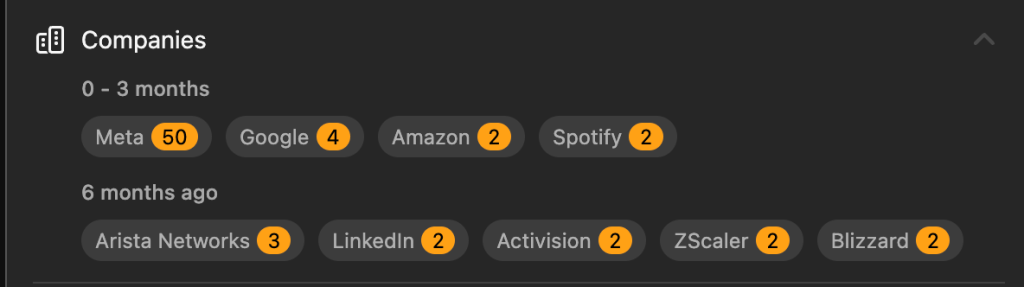
    This is a premium problem on LeetCode and has also been asked by Meta as of the date of publishing almost 50 times.
    The problem statement is pretty simple, given an incoming integer stream, you have to calculate the simple moving average. The size or the window is also given.

    class MovingAverage:
    
        def __init__(self, size: int):
            
    
        def next(self, val: int) -> float:


    # Your MovingAverage object will be instantiated and called as such:
    # obj = MovingAverage(size)
    # param_1 = obj.next(val)
    

    Now a naive solution would be to initialise a data structure like an array and keep appending elements which are given in the next method and then compute the average of the last n elements, n being the size, every time.

    from statistics import mean
    class MovingAverage:
    
        def __init__(self, size: int):
            self.size = size
            self.nums = []
    
        def next(self, val: int) -> float:
            self.nums.append(val)
            return mean(self.nums[-self.size:len(self.nums)])
    

    Now this will work, but there are two issues here. One we’re storing elements not required, meaning we only need to store the latest numbers till the dimension of size. Also, there is a lot of repeated work here, where we’re calculating the mean every time. Making this solution O(N) in time complexity and also O(N) in space complexity.

    We can improve on both aspects. First, we will use a queue to store our numbers. The reason for doing so is that once the size of the queue becomes equal to our window size. We will pop elements from the left and add the numbers on the right. To do this efficiently, we will use the deque data structure in python.
    We will also create a variable called sum, where we will track the running sum. This will allow us to compute the moving average in O(1) time complexity.

    from collections import deque
    class MovingAverage:
    
        def __init__(self, size: int):
            self.size = size
            self.sum = 0
            self.vals = deque()
    
        def next(self, val: int) -> float:
            if len(self.vals) >= self.size:
                self.sum -= self.vals.popleft()
            self.sum+=val
            self.vals.append(val)
            return self.sum/len(self.vals)
    

    Here, you can see that we keep track of what the size of our self.vals is. If it exceeds the window size, we pop from the left and decrease our running sum.
    No matter what the size is, we always increment our sum and also append the number to our queue.

    There might be some minor improvements, but in terms of time and space complexity, this is the most optimal solution.

    Let me know if you found this solution helpful. I’ll be posting more LeetCode solutions on the blog as I feel they are also an integral component to cracking Machine Learning jobs, especially at Meta, Google etc.

  • Build Fully Local RAG Application with LLaMA 3: A Step-by-Step Guide

    Build Fully Local RAG Application with LLaMA 3: A Step-by-Step Guide

    Meta just launched Llama 3 and its the best open source LLM you can use. So why not build a RAG Application using it. You can use the model for text-generation using either HuggingFace or Ollama, we will be using Ollama to create a RAG application which will run locally.

    In this tutorial, we will build a Retrieval Augmented Generation(RAG) Application using Ollama and Langchain. For the vector store, we will be using Chroma, but you are free to use any vector store of your choice.

    In case you just want the collab notebook, it’s available here.

    There are 4 key steps to building your RAG application –

    1. Load your documents
    2. Add them to the vector store using the embedding function of your choice.
    3. Define your prompt template.
    4. Deinfe your Retrieval Chatbot using the LLM of your choice.

    First we load the required libraries.

    # Loading required libraries
    import os
    from langchain.text_splitter import RecursiveCharacterTextSplitter
    from langchain_community.document_loaders import PyPDFLoader
    from langchain_community.vectorstores import Chroma
    from langchain.chains import RetrievalQA
    from langchain.memory import ConversationSummaryMemory
    from langchain_openai import OpenAIEmbeddings
    from langchain.prompts import PromptTemplate
    from langchain.llms import Ollama

    Then comes step 1 which is to load our documents. Here I’ll be using Elden Ring Wiki PDF, you can just visit the Wikipedia page and download it as a PDF file.

    data_path = "./data/Elden_Ring.pdf"
    text_splitter = RecursiveCharacterTextSplitter(
        chunk_size=2000,
        chunk_overlap=30,
        length_function=len,)
    documents = PyPDFLoader(data_path).load_and_split(text_splitter=text_splitter)

    In case you want to learn in detail about ChromaDB, you can visit our detailed guide to using ChromaDB. The next step is to use an embedding function that will convert our text into embeddings. I prefer using OpenAI embeddings, but you can use any embedding function. Using this embedding function we will add our documents to the Chroma vector database.

    embedding_func = OpenAIEmbeddings(api_key=os.environ.get("OPENAI_API_KEY"))
    vectordb = Chroma.from_documents(documents, embedding=embedding_func)

    Moving on, we have to define a prompt template. I’ll be using the mistral model, so its a very basic prompt template that mistral provides.

    template = """<s>[INST] Given the context - {context} </s>[INST] [INST] Answer the following question - {question}[/INST]"""
    pt = PromptTemplate(
                template=template, input_variables=["context", "question"]
            )

    All that is left to do is to define our memory and Retrieval Chatbot using Ollama as the LLM. To use Llama 3 as the LLM, all you have to do is define “llama3” as the model name.

    rag = RetrievalQA.from_chain_type(
                llm=Ollama(model="mistral"),
                retriever=vectordb.as_retriever(),
                memory=ConversationSummaryMemory(llm = Ollama(model="mistral")),
                chain_type_kwargs={"prompt": pt, "verbose": True},
            )
    rag.invoke("What is Elden Ring ?")
    >>> {'query': 'What is Elden Ring ?',
     'history': '',
     'result': ' Elden Ring is a 2022 action role-playing game developed by FromSoftware. It was published for PlayStation 4, PlayStation 5, Windows, Xbox One, and Xbox Series X/S. In the game, players control a customizable character on a quest to repair the Elden Ring and become the new Elden Lord. The game is set in an open world, presented through a third-person perspective, and includes several types of weapons and magic spells. Players can traverse the six main areas using their steed Torrent and discover linear hidden dungeons and checkpoints that enable fast travel and attribute improvements. Elden Ring features online multiplayer mode for cooperative play or player-versus-player combat. The game was developed with inspirations from Dark Souls series, and contributions from George R.R. Martin on the narrative and Tsukasa Saitoh, Shoi Miyazawa, Tai Tomisawa, Yuka Kitamura, and Yoshimi Kudo for the original soundtrack. Elden Ring received critical acclaim for its open world, gameplay systems, and setting, with some criticism for technical performance. It sold over 20 million copies and a downloadable content expansion, Shadow of the Erdtree, is planned to be released in June 2024.'}

    In sum, building a Retrieval Augmented Generation (RAG) application using the newly released LLaMA 3 model, Ollama, and Langchain enables robust local solutions for natural language queries. This tutorial walked you through the comprehensive steps of loading documents, embedding them into a vector store like Chroma, and setting up a dynamic RAG application that retrieves and generates responses efficiently. By harnessing the power of the newly released LLaMA 3 by Meta as the LLM and Langchain to create the chatbot, you can create intelligent systems that significantly enhance user interaction and information retrieval. The capabilities demonstrated here illustrate just a fraction of the potential applications. Let me know in the comments if you want me to cover something else.